Rom-com Maan Jao Na's trailer is out now

Crew Films' Maan Jao Na, a rom-com about the ups and downs of young love, is set to release next year.

The film's trailer released yesterday, and it appears to be lighthearted fare.


Musician/actor Adeel Chaudhry makes his Pakistani debut with this film and thinks it's just the right film for Pakistani audiences at this time.

"These are the kinds of films people want to watch right now. There's already so much depression and turmoil when it comes to politics and security. So this will be a welcome treat for cinemagoers."

Talking about the film, he shares, "My character Faris is a guy who's really fun-loving. He's a doston ka dost (i.e., a good friend to all his pals). He's in love with his best friend Rania (Naaz Norouzi) but is scared to tell her because he doesn't want to ruin their friendship. Rania is a free-spirited girl who doesn't believe in marriage or love and has always thought of Haris only as a good friend."

"When other people get involved and rishtas for Naaz start pouring in, Haris starts feeling insecure. How he tries to win her heart, what he goes through, that you'll have to watch in the cinemas."


Adeel also shared with Images that the film's shoot was a challenge.

"Not only did we shoot the film in one stretch over 38 days, I also did all the stunts. The weather's rarely ever harsh in Karachi, but we had a cold spell during which I had to dive into the deep sea and sims around for 45 minutes! It was probably 5 to 6 degree at Hawkes Bay."

"I also did the fight sequences myself and rode my first bike — an 1800 cc Harley Davidson! When you do the stunts yourself, the film gets a more realistic feel."

Maan Jao Na comes out on February 2, 2018.

CPEC enters the next phase

THE two-day Joint Cooperation Committee (JCC) meeting of the China-Pakistan Economic Corridor (CPEC) sets the stage for the second phase of the multibillion-dollar cooperation between the two nations.
It attempts to formalise the future roadmap for industrial and economic collaboration involving special economic zones along the CPEC stretch in Pakistan and adopt a Long Term Plan (LTP) 2030.
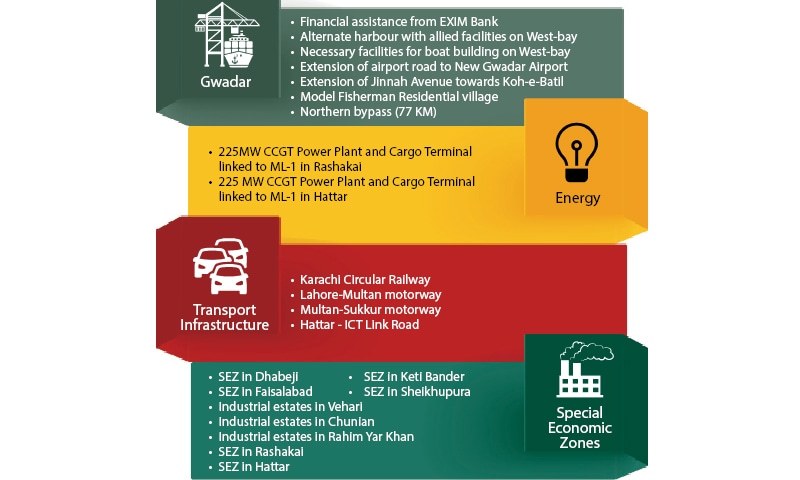
The main focus of the seventh JCC will remain special economic/industrial zones even though all the five joint working groups (JWGs) — Gwadar, energy, transport infrastructure, special economic zones and planning — would meet on the first day (today) to remove any irritant and suggest the way forward.
The JWGs comprise secretary-level officials of the two countries. The new projects, mostly small to medium size, will be finalised by these groups for inclusion in the overall portfolio.
Even though Pakistan had originally lobbied for its financing, it has already been settled in recent interactions that the $14 billion Diamer-Bhasha Dam would not be made part of the CPEC because of unacceptable demands from Beijing for the transfer of its ownership.
The key projects expected to formally become part of the CPEC are $8bn Main Line-I (the 1,875km railway line from Karachi to Lahore to Peshawar) and $3.5bn Karachi Circular Railway. The financial appraisal of these new projects has been completed and their future course of action will be approved.
On the second day, the JCC — led from the Chinese side by vice-chairman of the National Development and Reforms Commission (NDRC) and from the Pakistani by Minister for Planning Development and Reform Ahsan Iqbal — will meet all the four chief ministers, heads of regional governments and the Federation of Pakistan Chambers of Commerce and Industry.

Pentagon persuades Congress to delink LeT from Haqqani network


WASHINGTON: The US Depart­­ment of Defence persuaded Cong­ress to drop a provision that linked reimbursements to Pakis­tan with a demonstrable action against Lashkar-e-Taiba (LeT), diplomatic sources and media reports said.
The move came days before the visits of two senior most US defence officials to Islamabad — Defence Secretary James Mattis and Joint Chiefs of Staff Chairman Gen Joseph Dunford.
Gen Dunford, who arrives in Islamabad early next week, will hold extensive talks with the country’s military leadership. Secre­tary Mattis, who arrives on Dec 3 for a day, will hold the final talks.
On Thursday, Congress passed a bill, which includes $700 million for Pakistan reimbursement for deploying forces along the Pak-Afghan border, but withheld half the amount. To receive the withheld amount, Pakistan has to take demonstrable action against the Haqqani network, which Washing­ton says still has hideouts in Fata and uses them for launching attacks inside Afghanistan.
An earlier version of the National Defence Authorisation Act, 2018 had named two militant groups — the Haqqani network and LeT. But the final bill only mentioned the Haqqani network. Lashkar was taken off the list.
Quoting sources in the Senate and House armed services committees, US and Indian media reported on Sunday that the Pentagon played a key role in removing LeT from the list.
One report claimed that in their meetings with members of the two committees, Pentagon officials insisted that curbing the Haqqani network “must remain the top priority and adding LeT was like shifting the goal post for Pakistan”.
The report said that while the omission disappointed the Indian government, it was satisfied with the overall US policy of reducing its assistance to Pakistan.
The condition for releasing the withheld amount requires the US secretary of defence to certify that Pakistan has taken the suggested “demonstrable action” against the proscribed group.
Since 2016, when this condition was first attached to the bill, Pakistan has lost about $750 million in Coalition Support Fund, which is used for reimbursing Islamabad.
Diplomatic sources in Washing­ton point out that the Pentagon’s decision to use its influence to remove LeT from the list showed Washington’s desire to keep Pakistan on its side.
Despite their disappointment with Islamabad’s alleged refusal to take on the Haqqani network, policy makers in Washington see Pakistan as key state in a very sensitive region. They point out that Pakistan is a nation of more than 200 million people with a large middle class, which has nuclear weapons as well.
They also acknowledge that the country provides the shortest land route for supplying US forces in Afghanistan.

Breakthrough in sight after talks with Islamabad protesters

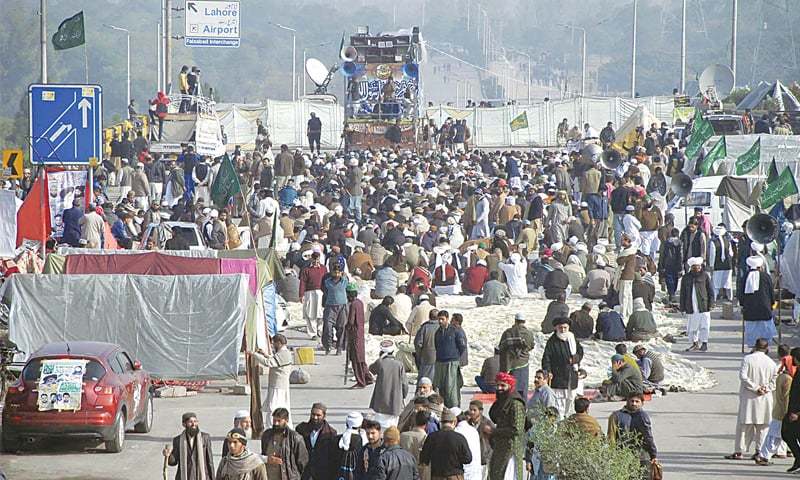
ISLAMABAD: Signs of a negotiated end to the sit-in organised by some religious parties at Faizabad emerged on Saturday night when a ministerial-level government team held marathon meetings with the protest leaders.
Reports claimed the government had offered the sit-in leaders that all cases registered against them would be withdrawn and a committee would be appointed to look into claims that Law Minister Zahid Hamid was behind the now-withdrawn controversial change into the Khatm-i-Nubuwat declaration for electoral candidates.
The representatives of the protest leaders were expected to give their response to the offer after consulting their leadership

CPEC's next phase to enable technology transfers from China to Pakistan: Ahsan Iqbal

Minister for Planning and Development Ahsan Iqbal on Tuesday said the cooperation envisioned in the industrial sector under the China-Pakistan Economic Corridor (CPEC) project will ensure the transfer of technology, knowledge, and skills to Pakistan.
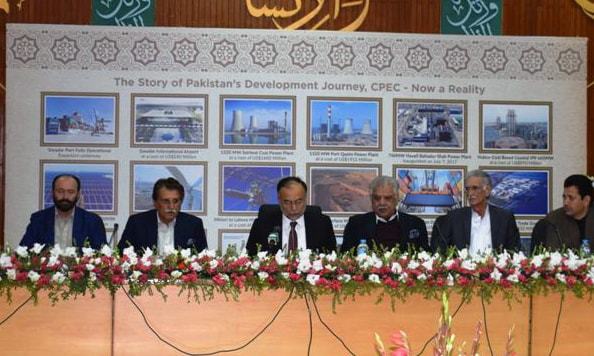
“CPEC is helping promote a knowledge-based economy in Pakistan,” the minister said while addressing the seventh meeting of the Joint Coordination Committee (JCC) of CPEC, held in Islamabad to review and approve various development projects.
Ahsan Iqbal and his Chinese counterpart jointly presided over the meeting.
More than 150 officials from Pakistan and China were in attendance. The chief ministers of all provinces, along with Azad Jammu and Kashmir Prime Minister Raja Farooq Haider, were also present.
Moreover, the private sector was allowed to participate in the meeting for the first time.
Ahsan Iqbal said that the 7th JCC meeting was a milestone towards realising the potential of CPEC and noted that the people of Pakistan valued the multifaceted cooperation extended by the government and people of China to Pakistan.
He said the project was now heading towards completion of its first phase and the JCC meeting was of historical significance in the finalisation of the long-term project.
“The long-term plan will give new dimensions to the bilateral cooperation between China and Pakistan,” he said.
The minister said that the project would expand the scope of co-operation in various new areas, including the social sector, whereas, education and health sectors would also be upgraded.
Talking about Gwadar, Iqbal said that projects in Gwadar were of utmost importance for the people of the area as well as national development.

Cooperation is vital for public to benefit from CPEC

Prime Minister Shahid Khaqan Abbasi, during a meeting with a Chinese delegation led by China's Assistant Foreign Minister Kong Xuanyou, highlighted the need of an increase in cooperation between the two countries in order to ensure that the people benefit from CPEC.
Abbasi expressed satisfaction that the energy and infrastructure projects under CPEC were progressing smoothly, Radio Pakistanreported.
The matters pertaining to bilateral trade, security and law and order situation in Afghanistan were also discussed during the meeting, the report added.
The Chinese delegation had met Foreign Secretary Tehmina Janjua in Islamabad for the eighth round of strategic talks between Pakistan and China.

Opposition bid to restrict disqualified persons from holding party office foiled by govt

The National Assembly on Tuesday rejected — by a margin of 98 for, 163 against — a bill presented by PPP lawmaker Syed Naveed Qamar that sought to remove Section 203 from the Elections Act 2017.
The clause had allowed former prime minister Nawaz Sharif to retake his position as the president of PML-N following his disqualification by the Supreme Court (SC) on grounds that he was not 'honest'.
"Someone who is not sadiq [truthful] and ameen [honest] in the view of the apex court should not be eligible to hold party office," Pakistan Tehreek-i-Insaf (PTI) Vice Chairman Shah Mehmood Qureshi observed while throwing his weight behind the legislation.
He said the rule had been introduced because "a party head controls the party's policies" and criticised Prime Minister Shahid Khaqan Abbasi for allowing it to be dismantled, saying: "It is evident that the incumbent prime minister toes the line of the former prime minister."
"The insertion of Section 203 is a direct confrontation with the Supreme Court and in conflict with the Constitution," he said.
Qureshi also said that any legislation which only facilitates a particular individual cannot be termed "good legislation". "Your party has been ruling for the past 30 years. Isn't there one person [in your party] who is eligible [to head it] according to Article 62 [of the Constitution]?" he asked.
"Can you not even trust your brother? Can you not trust a senior parliamentarian like Nisar Ali Khan?" Qureshi added.
Opposing the bill, Law Minister Zahid Hamid said the real irony was that those belonging to the party of Zulfikar Ali Bhutto were opposing a move similar to one condoned by him.
He explained that the conditions for disqualification of political personality had been introduced through Section 5 of the Political Parties Act of 1962.
"When Bhutto came into power, the said article was removed in 1975 and no one objected until 2000," Hamid said.
"In 2000, [then] President Musharraf introduced the Political Parties Order 2000 because he wanted to keep Benazir Bhutto and Nawaz Sharif out," the law minister claimed.
He also recalled that none of the parties had objected when a committee and a sub-committee of the parliament looking into the Elections Act had suggested removing the provisions related to disqualification.
"The suggestions [of the sub-committee] went to the committee and a report was published. It was presented before this house and in the Senate. Everyone saw it and no one objected," Hamid recalled, adding that all of this happened before the Panama Papers had seen the light of day.
Hamid instead turned the tables and said that it was the amendment presented to parliament by the opposition that was person-specific, rather than the one the government had presented and approved after a proper review by a parliamentary committee and all political parties.
"If legislation is brought to benefit a single person the country's system is adversely affected," Naveed Qamar stated in response.
“If the bill does not pass [today], it will need to be presented before a joint session, since it has already been approved by the Senate,” he said.
Speaking before the law minister, PPP lawmaker Dr Azra Afzal said: "For one person, this house gets full; but it’s a disgrace that the house is empty when a proper and meaningful resolution is in order."
She was referring to the continued absence of lawmakers in large numbers from both houses of the parliament, which has thwarted legislation on key issues, including the passage of a constitutional amendment that will enable the upcoming general elections to be held on the basis of the provisional results of the 2017 census.
Opposition Leader Khursheed Shah added some sharp criticism of the law minister: "I pity Zahid Hamid," he began. "From 2002 to 2007, this man would defend Musharraf in the same manner as he is defending Nawaz Sharif today."
He, too, was quick to appreciate the unusually high attendance.
"The presence of members in the house increases its stature," Shah said dryly.
Also speaking on the occasion, Railways Minister Khawaja Saad Rafique said the PML-N was fighting the battle for democracy in the country.
"We will not allow a handful of people to decide the fate of 210 million people," he said in defence of his party's decision to stick with Nawaz as the only choice for its leadership.
After the assembly's business on the bill was done and dusted, the ousted prime minister's daughter sent out a Tweet that stated that Nawaz Sharif was not "one person" but an "ideology".
"One man. One man. One man," Maryam Nawaz began. "Everybody came together to 'minus' one man [from the political order] but they couldn't be successful because he was not one man."

Chinese tech giant Tencent surpasses Facebook in value

Chinese social media and video game giant Tencent became more valuable than Facebook on Tuesday as investors sent the company soaring into the top five of the world's biggest firms.
Tencent's Hong Kong-listed shares have doubled in value this year, and on Monday it became the first Asian company with a market capitalisation of half-a-trillion dollars.
By the end of the trading day on Tuesday, Tencent's outstanding shares were worth a combined $523 billion, surpassing Facebook's $519 billion.
Despite its stratospheric climb, Tencent is still some way behind the world's most valuable company, Apple, which is currently valued at $873 billion.
Last week, Tencent said profit had grown nearly 70 per cent in the third quarter, when compared with the same period last year, outpacing expectations. Its accelerating growth has sent its shares shooting higher in recent days.
Critics say many of China's tech companies copy the latest idea seen in the United States. That has not been the case for Tencent, which has transformed its WeChat smartphone app into a product wholly unlike other social networking applications that are being used around the world.
“Tencent is an enterprise that focuses on innovation,” said Huang Hao, an associate researcher at the National Academy of Economic Strategy of Chinese Academy of Social Sciences. “Its product ideas are not simple emulations of those of foreign businesses.”
But it also has a distinct advantage over some of its western peers: Facebook and Twitter are blocked in China, cutting off a market of up to 1.3 billion people.

Cashless society

The nearly one billion users who flock to Tencent's WeChat app, and older platform QQ, can chat, post photos, play games, transfer money and pay for a variety of services in China. They exchange 38 billion messages each day.
WeChat has revolutionised China's tech industry and even daily life for millions of Chinese.
WeChat's QR codes, which look a lot like a barcode, are ubiquitous in China's shops and restaurants, and even fruit hawkers and some beggars carry around the scannable codes, allowing them to accept mobile payment.
The Wepay service, along with its competitor made by Alibaba, has helped China jump from a cash-based society to one at the global forefront of mobile payments.
Even the media and publishing sectors have seen changes in the way Chinese consume and pay for content, with millions of WeChat accounts publishing content directly to their followers.
That has rubbed up against Chinese censors, who shut down dozens of accounts publishing the latest tidbits of celebrity gossip over the summer.
Another key to Tencent's success has been its top game, the multi-player online battle “Honour of Kings”, which has been a smash hit that helped Tencent's revenue from smartphone games surge by 84 per cent in the third quarter.
Tencent's disruption of industries traditionally dominated by the state has also angered a number of behemoths — from the publishing to telecommunications to banking sectors.
These powerful enemies could pose a problem for the tech giant in the future, analysts say.
“Most of its profits are obtained by foreign investors,” said Huang of the government research institute.
“The government should face up to this issue and consider the ways to promote the development of entirely national enterprises in the future,” he said.